Eggplant Generator 1.2 Release Notes
Eggplant Generator Release 1.2 (November 2025)
Version 1.2 of Eggplant Generator (hereafter called "Generator") includes the following enhancements and fixes:
Requirements Scoring and Adaptable Generation
Generator now assesses and scores your inbound requirements, giving actionable feedback at a per-requirement level on variations in language clarity (Syntax), the clarity of the meaning of the requirement (Semantics), and how rich and detailed the requirement specification (Complexity). The scores are on a scale of 1 to 5, with 5 being the highest. Generator evaluates each requirement automatically upon import and provides meaningful feedback on how it interprets them.
Based on the assessed score, Generator then dynamically adjusts its generation approach, fine-tuning its internal parameters to better handle simple, complex, or ambiguous requirements. These assessments and adjustments ensure the best possible generated Gherkin scenarios and test cases for each individual requirement. This feedback can, of course, be used to improve clarity and detail in your requirements before regenerating assets.
Following are examples of Generator's requirement assessment and scoring:
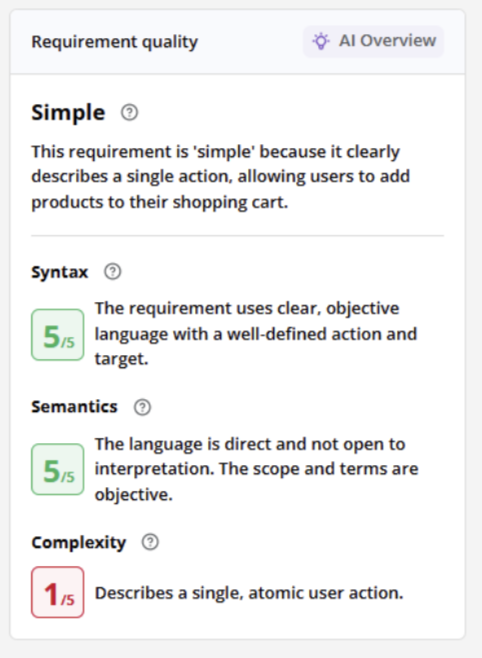
Example 1: Shows a requirement that Generator categorized as 'Simple' because it clearly describes a single action. It scored Syntax as a 5, Semantics as a 5, and Complexity as a 1 for the reasons shown.
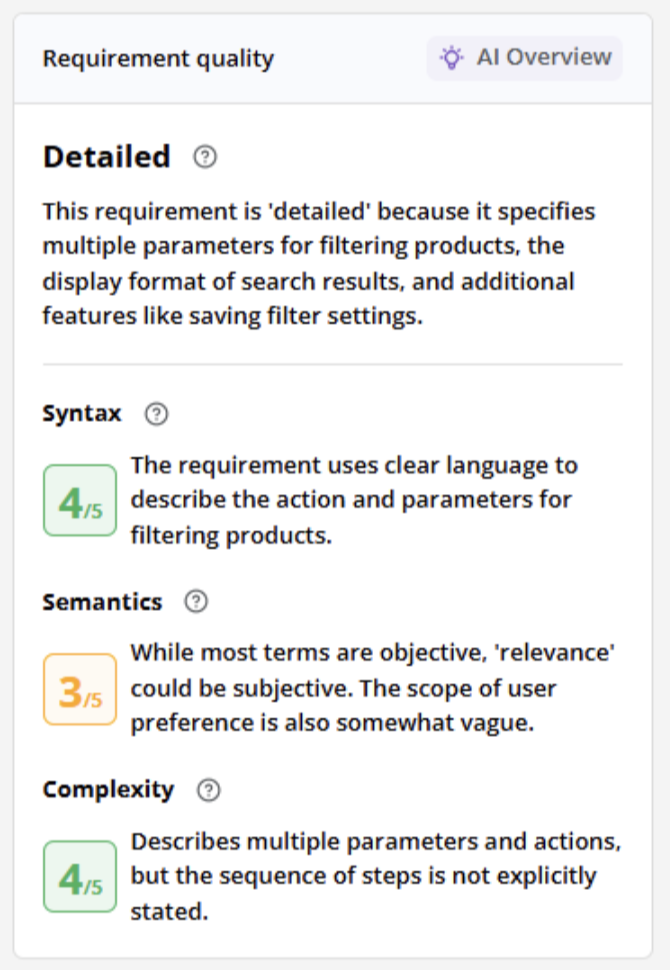
Example 2: Shows a requirement that Generator categorized as 'Detailed' because it specifies multiple parameters for filtering products. It scored Syntax as a 4, Semantics as a 3, and Complexity as a 4 for the reasons shown.
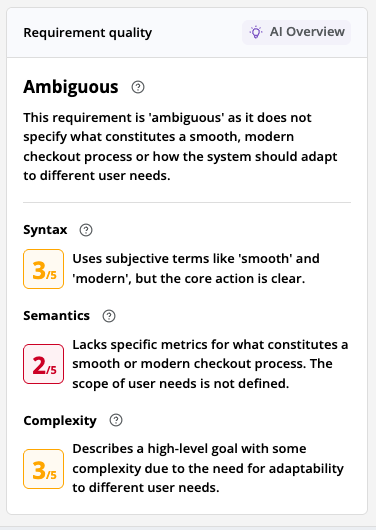
Example 3: Shows a requirement that Generator categorized as 'Ambiguous' because it does not specify what constitutes a smooth, modern checkout process. It scored Syntax as a 3, Semantics as a 2, and Complexity as a 2 for the reasons shown.
Test Case Format and Expected Result Per Test Step
Generator 1.2 improves the format of generated test cases to provide a meaningful Expected Result at every step of the test, not just a single expected result at the end. This allows better continuous inspection of the application under test as the test is executed, as each step action has a corresponding recommended assertion. Both automated and manual execution of these tests will benefit as it allows a system’s behavior to be better examined and asserted throughout a test’s flow, not just via a single expected outcome at the end.
Supported Format Exports for Test Case Management Systems
To make even better operational use of the new Expected Result for each test case, Generator 1.2 makes multiple different formats available for the downloadable Export format to more easily and intuitively be imported into some common test case management platforms. You can now download your test cases with structure and headers that match the expected format for the CSV test case import functions in Jira Xray, Jira Zephyr Scale, and TestRail. Where these tools will automatically detect the headers for import, they will match upon import. Where there is a need for an initial manual mapping, the headers will still match the corresponding test case property in your tool to eliminate any guesswork in the mapping. (And, once you do an initial mapping, you can usually save a mapping config file from your test case management tool to streamline future imports even further).
3rd Party Updates
| Component | Previous Version | Upgraded To |
|---|---|---|
| Keycloak | 26.3.0 | 26.3.4 |
Security Fixes
Generator v1.2 remediates the following vulnerabilities:
-
Upgrades
pypdfto remediate CVE-2025-55197. -
Upgrades
sha.jsto remediate CVE-2025-9288 BDSA-2025-9868. -
Upgrades
viteto remediate CVE-2025-31125, CVE-2025-30208, CVE-2025-31125, CVE-2025-30208. -
Upgrades
node-ipto remediate CVE-2025-59437, CVE-2025-59436.