Upgrade Notes
This page provides instructions for upgrading Eggplant DAI on Windows.
Downgrades are not supported.
Before you upgrade, you should back up the database folders and configuration file from your existing DAI Server installation on Windows. If there is a problem with your upgrade, you will want to restore your DAI Server to this point. If you have any questions or would like help testing your database before you upgrade, please contact your Technical Success Manager or our Customer Support.
Backing Up or Restoring the DAI Server
Below you will find information about how to back your existing DAI Server data, as well as instructions for restoring it. Click the appropriate tab below for the information you want.
- Back Up DAI
- Restore DAI Data
To take a backup:
-
Stop the Digital Automation Intelligence Service through the Windows Services manager.
-
Copy the following DAI Server files and folders from the
C:\ProgramData\Eggplant\Digital Automation Intelligencedirectory somewhere outside theProgramDatadirectory, or to another machine or backup device, using File Manager or a command prompt:- The
datafolder - The
filesfolder for DAI versions 26.2.1 and higher orminiofolder for DAI versions 26.2.0 and older (Note that the 26.2.1 and higher Setup programs on Windows will migrate the data from theminiofolder if it exists to thefilesfolder) - The
config.ymlfile - The
settings.inifiles
ノートYou do not need to back up the DAI credentials because they are saved in the Windows Credential Manager
- The
-
Start the Digital Automation Intelligence Service.
-
Read the important upgrade notes below and then proceed to Install an Eggplant DAI Server.
If you experience a problem with an upgrade, and you need to restore the previously working DAI version, follow the steps below:
-
Repeat steps 1 and 2 under Back Up DAI to make a backup of the DAI files and data, which may be useful for troubleshooting.
-
Uninstall DAI using the Programs and Features option in the Windows Control Panel.
-
Delete folder
C:\ProgramData\Eggplant. -
Check if folder
C:\Program Files\Digital Automation Intelligenceexists and delete it if it does. At this point you have fully removed DAI from the machine. -
Install the previously working version of DAI. When you finish re-installing DAI, verify the installation by launching a browser and logging into the DAI web UI.
情報The previously working DAI version you install must be the same version that you took the backup files from.
-
Stop the DAI service from Windows Services.
-
Go to the
C:\ProgramData\Eggplant\Digital Automation Intelligencefolder and delete the following files and folders. (These are the files and folders you will replace from your backup.)- The
datafolder - The
filesfolder for DAI versions 26.2.1 and higher orminiofolder for DAI versions 26.2.0 and older (Note that the 26.2.1 and higher Setup programs on Windows will migrate the data from theminiofolder if it exists to thefilesfolder) - The
config.ymlfile - The
settings.inifiles
- The
-
Restore the files and folders listed above from the DAI backup location by copying them to
C:\ProgramData\Eggplant\Digital Automation Intelligence. The backup files must be from exactly the same DAI version that you installed in step 5. -
Start the DAI service, and after it starts, verify you can log into the DAI web UI.
Upgrading to 26.3.0
Version 26.3.0 is the latest release of DAI. The documentation on our Documentation website contain the latest information. If you are viewing this page offline, please check the website for the latest information: https://docs.eggplantsoftware.com/dai/dai-release-notes/.
Upgrading to 26.2.2
The documentation on our Documentation website contains the latest information about upgrading to the 26.2.2 release. If you are viewing this page offline, please check the website for the latest information: https://docs.eggplantsoftware.com/dai/dai-release-notes/.
There is a known issue navigating to a new page in DAI where the new page is blank. This issue occurs with Google Chrome version 150, and the Edge version based on it. It may also occur in later versions of these browsers. This issue impacts both on-premises Windows installations and (Linux) container deployments of the DAI Server.
-
DAI version 26.2.2 includes a fix that resolves this issue. You do not need to take any actions if you upgrade to DAI version 26.2.2.
-
DAI versions 26.2.1 and older, however, do not include a fix. Therefore, you must run a script to enable older versions of DAI to display properly in these versions of Chrome and Edge.
There are different scripts to fix the issue in the DAI Server: one for Windows installations and one for container deployments. See Supported Browsers on the Prerequisites page for information about running the script on Windows installations, and Software Recommendations for Eggplant Deployments with Kubernetes for information about running the script for container deployments.
Upgrading to 26.2.1
The Release Notes on our Documentation website contain the latest information. If you are viewing this page offline, please check the website for the latest information: https://docs.eggplantsoftware.com/dai/dai-release-notes/.
-
Eggplant 26.2.1 is the latest release of DAI. For improved security, the 26.2.1 release requires that you configure DAI to use the secure internet protocol (HTTPS) connections. HTTP connections are no longer supported. Please see Upgrading DAI 26.2.1 as Required for HTTPS below for important requirements related to this change. Please also see 26.2.1 Release Notes for general information about this security improvement.
-
You can upgrade to 26.2.1 from 26.2.0 or 26.1.x. However, you must upgrade to Eggplant DAI 26.1 before you start your 26.2.1 or 26.2.0 upgrade. If you are currently using version 25.4 or earlier, be sure to see Upgrading from 25.4 to 26.1 on Windows in the 25.4 version of the documentation for important information about upgrading to 25.4, which involves changes to execution environments and systems under test (SUTS).
- You must upgrade to Eggplant Functional 26.2.1.1 or 26.2.101.1 when you upgrade to DAI 26.2.1. DAI 26.2.1 is only compatible with Eggplant Functional (EPF) 26.2.1.1 or 26.2.101.1 due to the HTTPS changes.
-
The upgrade may take 10-20 minutes to complete.
Upgrading HTTP Installations to 26.2.1
If your existing DAI Server is configured to use HTTP, this upgrade requires you to make the following changes:
-
You will need to reconfigure your DAI Server to use HTTPS, which requires making a Transport Layer Security (TLS) certificate accessible to the DAI Server. The 26.2.1 Setup program provides a Server Configuration panel where you will provide the location of an existing certificate or choose to have Eggplant generate a self-signed certificate for you. See Configuring DAI 26.2.1 as Required for HTTPS below for information.
-
After you run the 26.2.1 Setup program to reconfigure your DAI Server to use HTTPS, you will need to regenerate the DAI
.inifiles for your environments because the.inifiles contain DAI URLs. See Regenerating the DAI .ini Files with HTTPS URLs below for more information. -
Additionally, after the upgrade, your users will need to use
httpsin the URL they use to access DAI in their browsers.
Configuring DAI 26.2.1 as Required for HTTPS
As stated above, you must reconfigure your DAI Server to use HTTPS connections. This configuration requires that you make a TLS certificate accessible to the DAI Server you are upgrading, and specify the location of the certificate when you run Setup to install the upgrade. Or, you can choose the option to have Eggplant generate a self-signed certificate for you when you run the Setup program to install the upgrade. For a high level summary, you have the following certificate options:
- An existing publicly trusted certificate authority (CA) certificate
- A private or enterprise certificate, for example, provided by your company
- A self-signed certificate signed and generated by Eggplant, which you can select during installation but is not recommended for production installations
To choose the right option for your site, please see the detailed explanations of the different certificate options and important information about their requirements on the new DAI Secure (HTTPS) Connections and Certificates page.
The 26.2.1 Setup program changed to include a new Server Configuration panel (shown below) where you can either specify the location of an existing certificate that you made accessible to the DAI Server system, or choose to have Eggplant generate a self-signed certificate during installation.
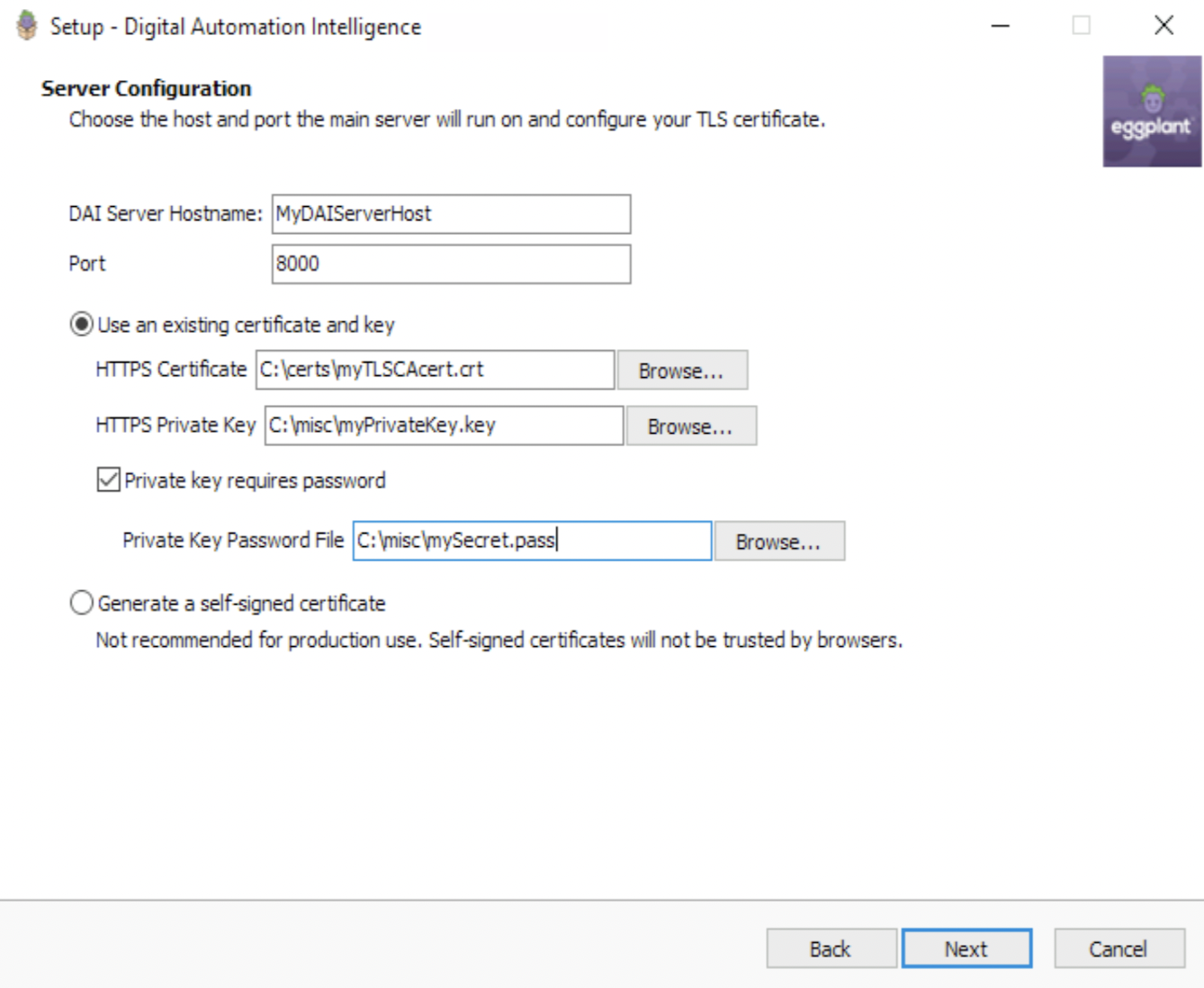
The Server Configuration panel in the DAI Windows Server Setup program introduced in DAI 26.2.1
Regenerating the DAI .ini Files with HTTPS URLs
After you run the DAI 26.2.1 Setup program to reconfigure your DAI Server to use HTTPS, you will need to regenerate the DAI .ini files for your environments. This is because each .ini file contains references to the DAI Server URL, and the regeneration process updates these references to HTTPS. See Regenerate an Access key on the Environments page for instructions.
Communicate the URL Change to HTTPS to your Users
After you upgrade and reconfigure DAI to use HTTPS, be sure to communicate to your existing users that they need to use https when they enter the URL in their browser to access DAI.
Migrating Internal Data
In 26.2.1, we migrated DAI data that was stored in Minio (object storage) to the file system. This migration will occur automatically after you upgrade. You do not need to take any actions for this migration to occur.
That said, you can verify that the migration occurred by looking at the DAI Server installation directory after you upgrade. On Windows, specifically, the upgrade moves the data to C:\ProgramData\Eggplant\Digital Automation Intelligence\files. The files folder contains two subfolders: one for storing screenshots captured during test runs and one for storing test suites if you are using DAI internal storage to store your suites. Before, with Minio, the data was stored in C:\Program Files\Eggplant\Digital Automation Intelligence\minio.
If you experience any issues with your upgrade that you think might be related to this migration, please contact Customer Support and ask them to help you verify the migration.
Spaces are here
The first time you log into DAI after upgrading to DAI 26.2.1, you will see the Spaces are here! panel. This is to inform you of the Spaces feature that was introduced in DAI 26.2.0. The Spaces page became the landing page you see when you log into DAI versions 26.2.0 and higher. For more information about upgrading to a release that has the spaces feature, see Upgrading from 26.1 to 26.2.0 below.
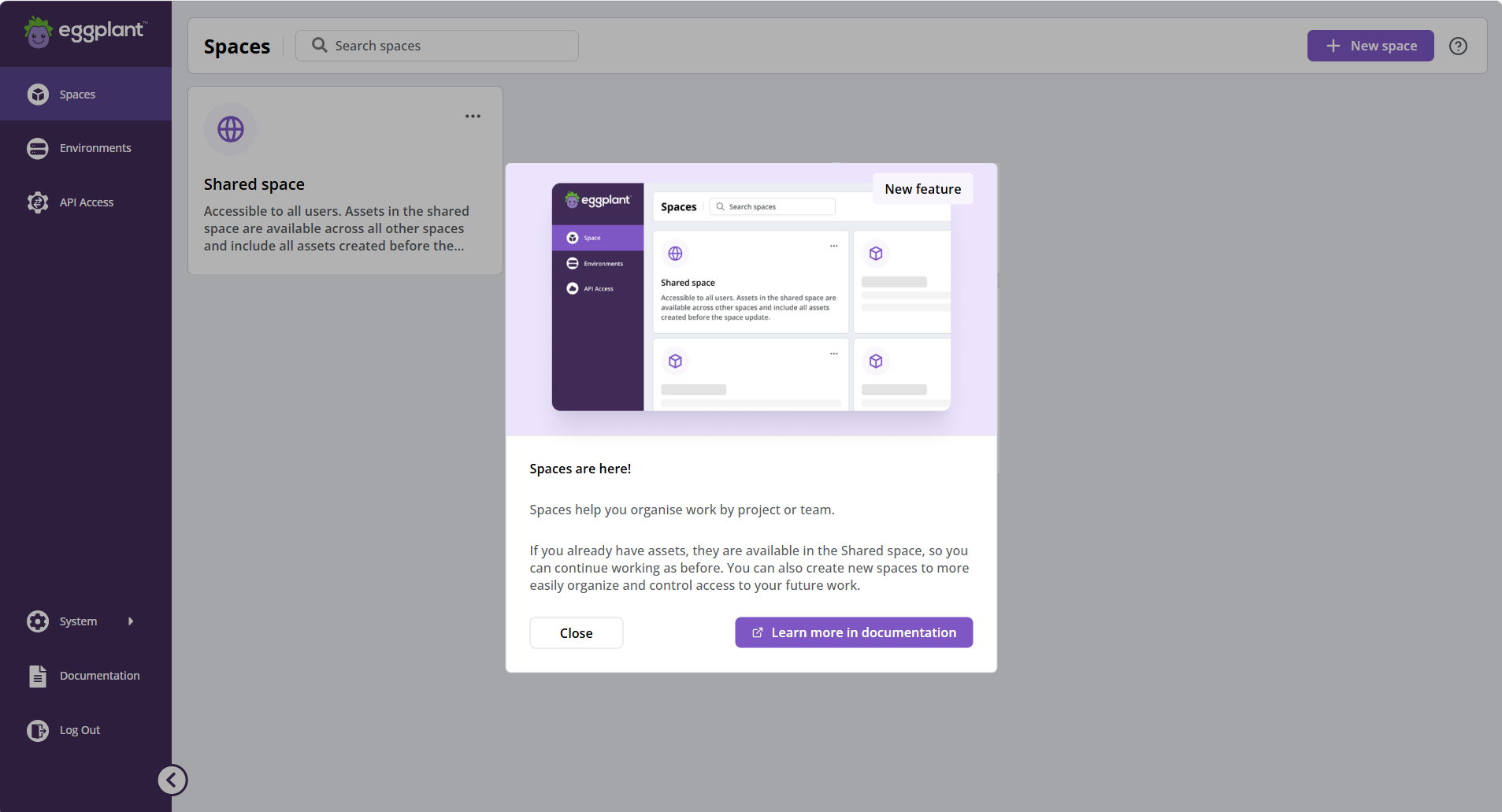
The Spaces are here! panel calling attention to Spaces feature in DAI
Upgrading from 26.1 to 26.2.0
-
You must upgrade to Eggplant DAI 26.1 before you start your 26.2.0 upgrade. If you are currently using version 25.4 or earlier, be sure to see Upgrading from 25.4 to 26.1 on Windows in the 25.4 version of the documentation for important information about upgrading to 25.4, which involves changes to execution environments and systems under test (SUTS).
-
The upgrade may take 10-20 minutes to complete.
-
Eggplant DAI 26.2.0 is only compatible with Eggplant Functional (EPF) 26.2. When you upgrade to Eggplant DAI 26.2.0, you must also update your version of EPF.
-
When you upgrade from 26.1 to 26.2.0 or higher, you will see that the Spaces page with its one Shared space is now the landing page when you log in. Spaces are a major new feature in DAI 26.2.0. Prior to version 26.2.0, you saw the Test case dashboard when you logged in.
All of your existing assets will be available in the Shared space when you upgrade. DAI Administrators can create and grant users access to new private spaces. However, all users can create new assets in any of the spaces they have permissions for. In a future release, you will be able to move your assets from the Shared space to any private spaces available to you. You can learn more about the Shared space on the About DAI Spaces page.
Additionally, you will likely notice that there are fewer option on the menu on the left. You need to open a space to see more of the DAI menu options. For example, if you click the Shared space, the Test case dashboard would open, and you would see more of the DAI menu items.
Finally, starting with 26.2.0, all environments must be associated with a space. By default, all environments are automatically available in the Shared space. However, a DAI Administrator (not just a Space Administrator) must explicitly select the spaces available to users in an environment as follows:
-
For existing environments, go to the environment's page (Environments > environment name). Admins will see a Spaces tab where you can select the spaces you want to be available in an environment. (The Spaces tab is in addition to the General tab, which has been available for environments).
-
If an Admin creates a new environment, only the General tab is visible until you save the environment at which time the Spaces tab displays so that you can select the spaces you want to be available with the environment.
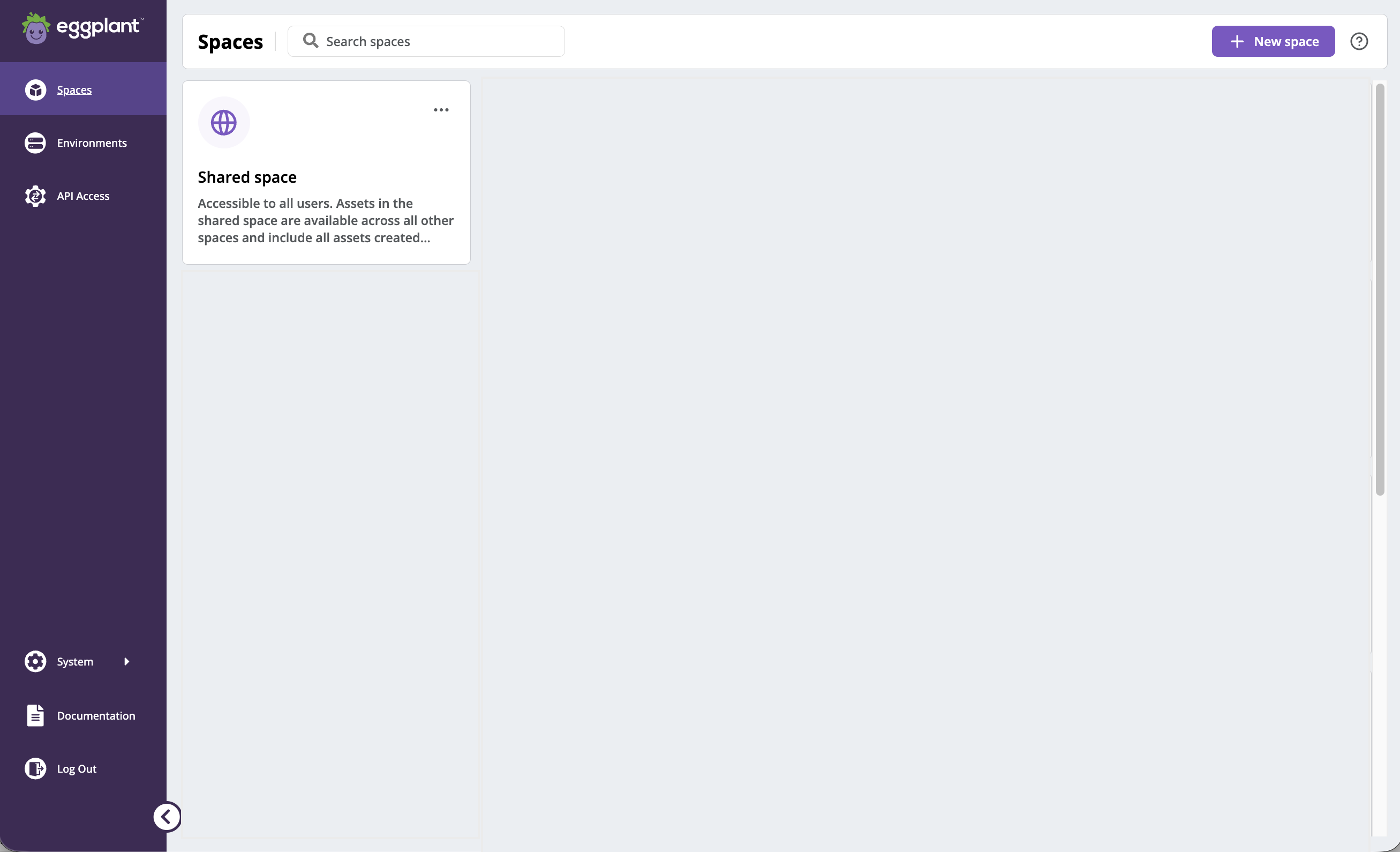
The new DAI Spaces feature page showing the common Shared space, which is now the landing page when you log into DAI
-
Upgrading Container Deployments
For information about upgrading DAI container deployments, see Upgrading on the Deploying Eggplant DAI in Containers page.
Upgrading Previous Versions of DAI
If you need information about upgrading earlier versions of DAI, please see the documentation for the specific version. You can display the documentation for different versions by selecting the version from the version selector at the top of the page.
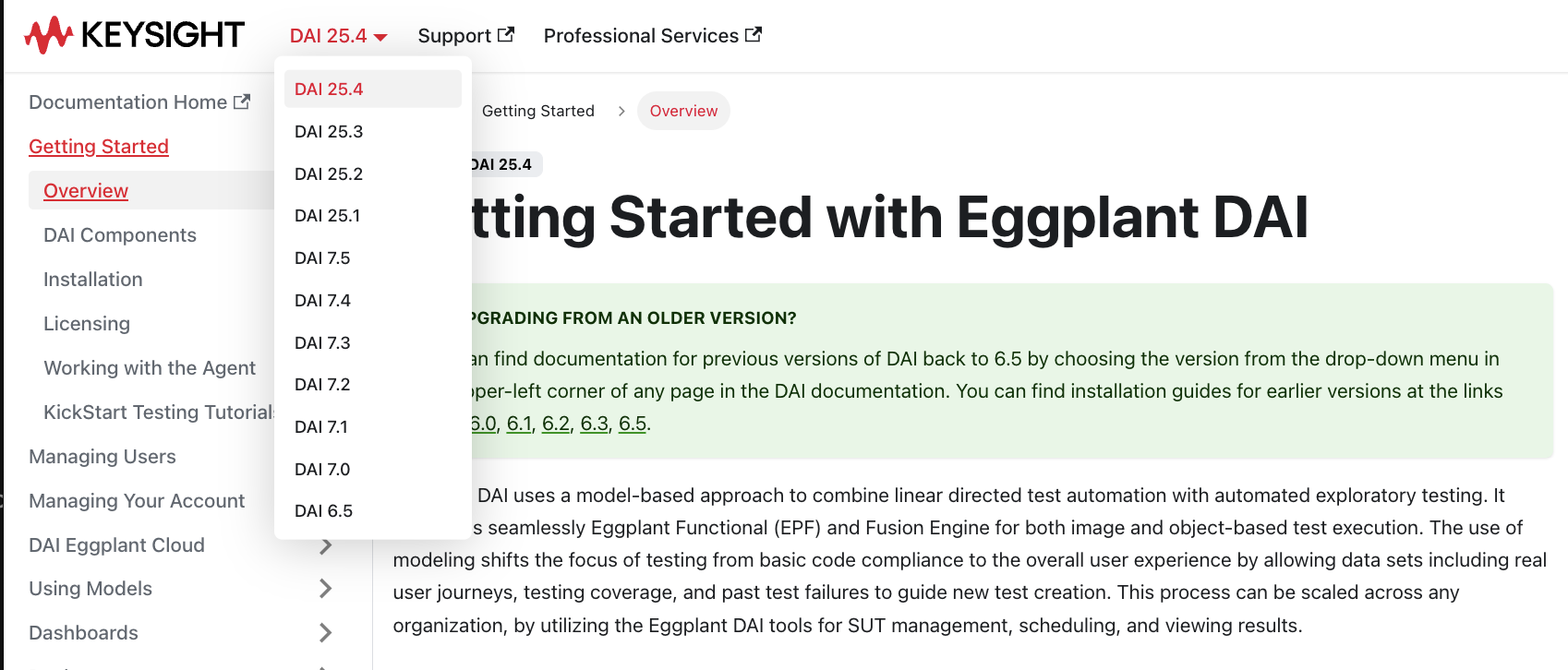
The Documentation version selector, which you can access from every page in the documentation